
How Do You Become a Comedian in Japan? Schools, Auditions, and Other Ways In
Agency-run schools, auditions, live performances, and personal introductions offer different starting points. Official documents and performers’ own accounts show how those paths can overlap.
There is more than one way to begin
Documented routes into Japanese comedy include agency-run training schools, auditions, self-organized performances, and personal introductions. Students appear among the applicants welcomed by one agency audition, while the M-1 Grand Prix comedy competition allows amateurs to enter. These opportunities can overlap, but starting to perform, entering a competition, and securing agency representation are different steps.
What does a comedy school lead to?
Yoshimoto Kogyo, a talent agency, dates the opening of its comedy school, NSC, to April 1982. In its corporate history, Yoshimoto describes establishing the school in response to growing interest from aspiring performers, after an earlier emphasis on apprenticeship under an established performer. That is the company’s account of its own development, rather than a history of every route into Japanese comedy.
A school’s connection to an agency also needs a closer look. Ohta Pro Entertainment College, the training school of talent agency Ohta Production, describes a staged process in its information for the 2027 intake. Performers who appear in the March graduation show receive six months of provisional affiliation, taking part in auditions and live shows alongside agency performers. A final review performance follows; only those who pass proceed to full agency affiliation from October.
How can an audition become a live opportunity?
An Ohta Production audition notice published on December 13, 2024, provides one concrete example. Applications have closed, but the notice sets out the sequence: applicants first underwent a document review, then successful applicants advanced to an in-person performance audition. Those who passed were to appear in a comedy show organized by the agency. The stated outcome was a live appearance, not an agency contract.
In an interview, one performer described a path that included making performance opportunities independently. The performer recalled forming a comedy group and using street performances to attract an audience, then later trying eight agency auditions before joining Sun Music, a talent agency.
In that interview, the performer described Sun Music’s process at the time as an audition with comedy material followed by appearances in a showcase for emerging comedians. Agency membership came after staff approval at the third appearance. It is a historical account of one performer’s experience, rather than current application guidance.
Where do students and amateurs fit?
The Ohta Production audition announced in December 2024 explicitly welcomed unaffiliated comedians, amateurs, and student comedians hoping to turn professional. That is a specific example of students being invited to present material for a professional performance opportunity.
A competition offers another setting. According to the M-1 Grand Prix’s 2026 entry rules, professional status and agency affiliation are not required. The organizers also list a Best Amateur Award for the amateur act that advances furthest through the qualifying rounds. These provisions concern entry and recognition within the competition; they do not promise representation or employment.
How do people find someone to perform with?
In an interview, a comedian described finding a future partner through an online message board for people seeking comedy partners. A post came from someone of a similar age who also lived in Tokyo. The two arranged to meet and formed a duo.
Finding a partner is not the outcome of every invitation. In a separate interview, a solo comedian recalled politely declining offers to team up by saying that the plan was to perform alone. Initially an excuse, that answer became a preference: solo performance grew enjoyable, and the comedian continued that way.
Can comedy begin after another career?
In a first-person account, a performer recalled working in construction after college while retaining an earlier interest in entertainment. An introduction led to a place in a theater company based at a variety theater in Shinjuku. The performer then began doing comedy in a trio with fellow actors. The account does not specify when those transitions happened.
A separate article reported that another performer had attended college and become a bank employee after an early plan to pursue comedy fell through. The article described a later conversation beside a river near the branch where the performer worked: an invitation to a childhood friend to pursue their old ambition together.
The next time you watch a duo or a solo act, consider how that working arrangement began: a message-board meeting, a theater connection, or a decision to keep performing alone.
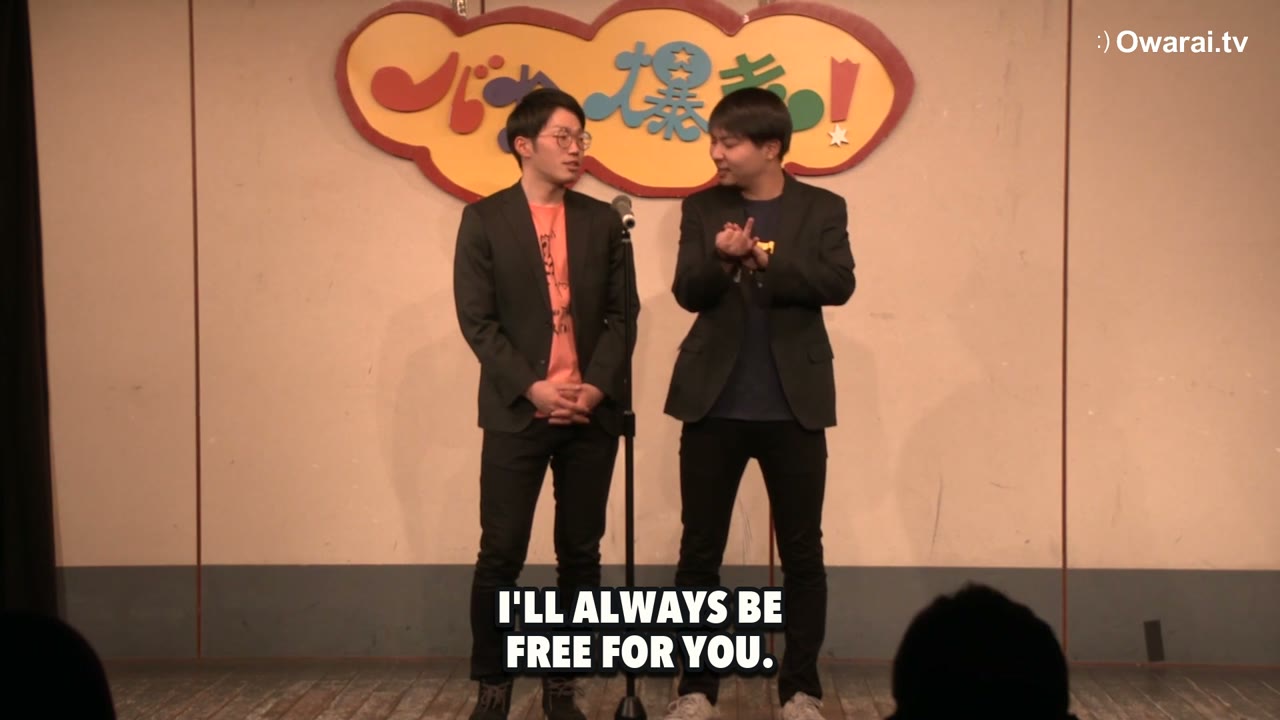 The Boyfriend Sales Pitch
A hopeful dater sweetens the pitch with every no. The friend listening won't budge.
3:36
Watch the whole thing (3:36)
The Boyfriend Sales Pitch
A hopeful dater sweetens the pitch with every no. The friend listening won't budge.
3:36
Watch the whole thing (3:36)
We use AI as part of how we create our articles.
Subtitles on this video: AI translation from the Japanese.