
Role Reversal in Japanese Comedy: Who’s Really in Charge?
A job title or a request for help can tell you who should be in charge. These three comedy routines invite you to watch who actually gets to set the terms.
What is role reversal?
Role reversal happens when the person you expect to call the shots loses that position to someone who initially seems less powerful. If you’ve watched a sitcom where a kid starts parenting the parent, you may recognize the pleasure of seeing a familiar relationship rearranged without anyone officially changing jobs. In the Japanese comedy routines below, that shifting balance works alongside exaggeration, repetition, and the performers’ contrasting personalities. You’ll see it in a short character sketch built around a situation, as well as in comic double acts whose back-and-forth conversation can include acting out an imaginary scene.
Follow who gets to set the terms
Start with a small question: who needs something from whom, and what would a normal response to that request look like? Keep that opening relationship in mind, then listen for who gets to ask questions, dismiss an objection, or decide what counts as a reasonable answer. To us, a particularly funny gap opens when someone still has the title or position of authority but has to work harder to make the other person cooperate. A shift in politeness or an unexpectedly serious response can be worth following, even while the routine gives you other things to laugh at.
Three routines to watch with this in mind
Honda Kyodai — “Shoplifting.” A store clerk stops a customer after an embarrassingly clumsy attempt at shoplifting. The clerk appears to have every advantage: a reason to confront the customer, the authority to enforce the rules, and the moral high ground. Watch what the clerk considers worth commenting on about the theft, and listen to how the customer responds. That specific choice of focus makes this sketch a useful place to explore the difference between having authority and deciding the tone of an encounter.
Leadoff Man — “I Want a Girlfriend.” A guy who can’t seem to find a girlfriend is talking with a friend he’s known since high school. Listen to how he presents his appeal as a potential boyfriend: what does he consider a selling point, and how does his friend receive it? Their shared history gives the conversation a different starting point from the store sketch—these are longtime friends, without a job title to settle who gets to direct the exchange. Watch this one for the way a personal wish becomes something another person is asked to take seriously.
Camel — “Hair Removal Salon.” One member of the duo has a beard that’s getting thicker and wants to practice going to a hair-removal salon. He asks his partner to play a staffer and says a rough version will do. Focus on that casual instruction: how much effort does the person asking for help expect, and how seriously does the person playing the employee take the assignment? The rehearsal gives you two relationships to follow at once, between customer and employee and between the partners trying to act out the visit.
Keep the opening relationship in mind, and even a small change in who gets to make the rules can become a joke.
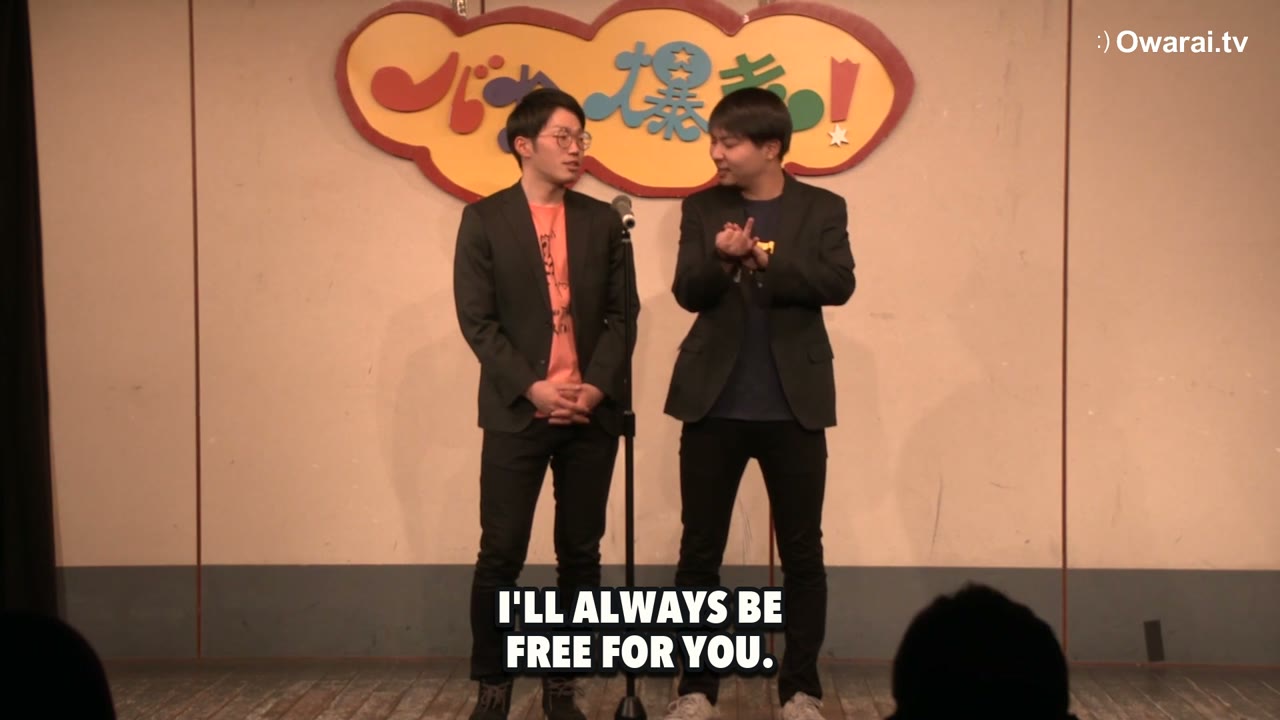 The Boyfriend Sales Pitch
A hopeful dater sweetens the pitch with every no. The friend listening won't budge.
3:36
The Boyfriend Sales Pitch
A hopeful dater sweetens the pitch with every no. The friend listening won't budge.
3:36
We use AI as part of how we create our articles.
Subtitles on this video: AI translation from the Japanese.