
Tendon in Japanese Comedy: How a Running Gag Works
A line, a gesture, a familiar exchange: tendon builds laughs by bringing a bit back. Learn what to watch for in three comedy routines.
A joke you get to recognize
In Japanese comedy, tendon (pronounced “TEN-dohn”) is a way of building a joke by bringing back the same line, action, or pattern. Think of a running gag: you recognize something you've encountered before, and that recognition becomes part of the pleasure.
Sometimes the words repeat; sometimes it's the shape of an exchange, with a fresh objection answered by another version of the same pitch. The appeal is in that mix of familiarity and renewed attention: you know the pattern well enough to notice what the performers do with it.
Follow what they won't let go
Once you notice a bit returning, listen for what's staying fixed—a phrase, a demand, a way of answering—and what feels different around it. The response is worth as much attention as the repeat: a partner's delivery can make the same idea feel welcome, baffling, or suddenly unreasonable.
Try asking what each character wants, because a repeated move becomes more interesting when you understand why someone won't let it go. If an English subtitle comes back word for word, use that as one clue, while listening for a repeated cadence even when the wording varies.
Three routines to try
These routines put repetition to different uses. A conte is a sketch with characters and a setting; manzai is a two-person stand-up exchange that can move into role-play.
Honda Kyodai, “Shoplifting” (conte). A store clerk stops an inept shoplifter, but seems more impressed than offended by how badly the theft has been attempted. Watch how the clerk's admiration keeps coming back: the person expected to object is the one most taken with the crime. The sibling duo gives you a specific focus for the repeats—the clerk's fascination with the customer's incompetence—making this a good starting point for spotting how a character's peculiar priorities can sustain a bit.
Leadoff Man, “I Want a Girlfriend” (manzai). A man frustrated by his lack of dating success talks with a friend he's known since high school. He has plenty to say about what he'd offer as a boyfriend, and each refusal prompts another selling point. Follow the qualities he chooses to advertise and how his friend handles each new offer. This is a good place to spot repetition in the shape of an exchange: the recurring move is to answer rejection by finding another reason he'd make a great boyfriend.
Camel, “Hair Removal Salon” (manzai). A man whose beard has been getting thicker wants to rehearse a salon visit, with his partner playing a female staff member. A rough rehearsal would suit him fine; his partner insists on taking the assignment seriously. Watch what each considers enough preparation: one wants a simple practice run, while the other cares about doing the role properly. Their disagreement makes the rehearsal itself worth watching, with the partner's commitment offering a different kind of persistence to follow.
Watch all three back to back to see how differently a repeated bit can work.
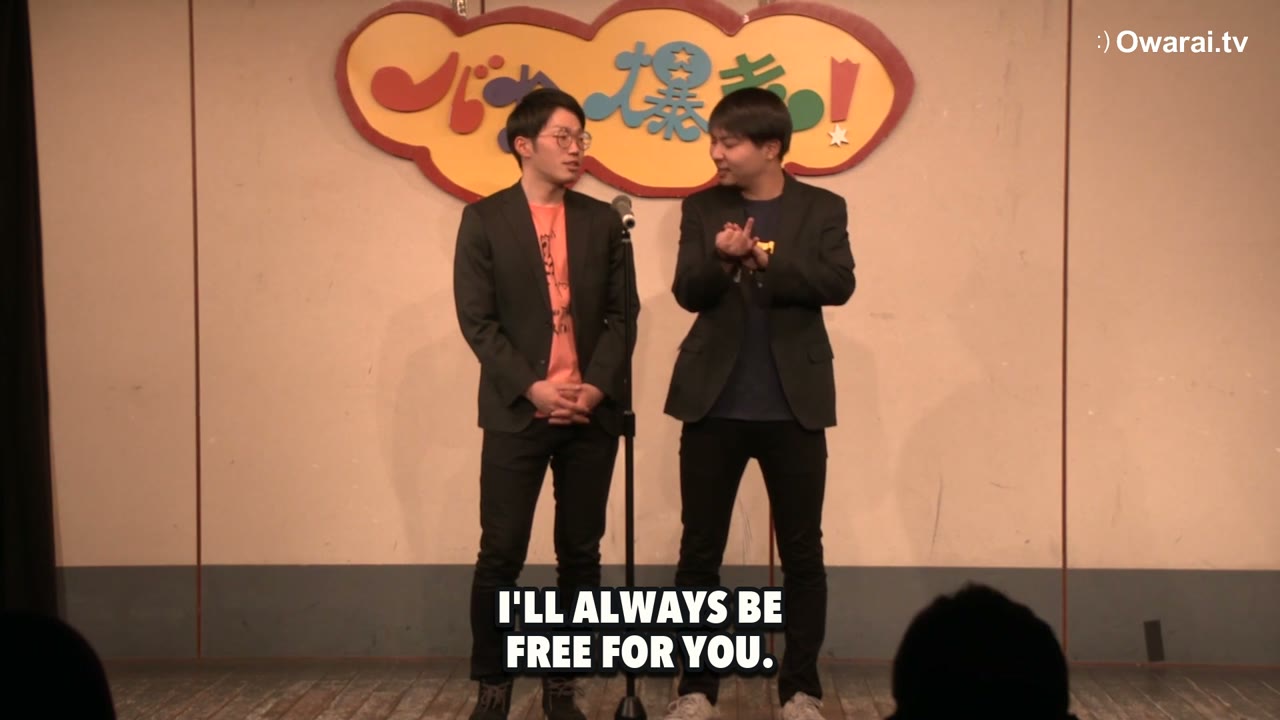 The Boyfriend Sales Pitch
A hopeful dater sweetens the pitch with every no. The friend listening won't budge.
3:36
The Boyfriend Sales Pitch
A hopeful dater sweetens the pitch with every no. The friend listening won't budge.
3:36
We use AI as part of how we create our articles.
Subtitles on this video: AI translation from the Japanese.